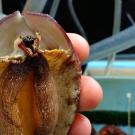
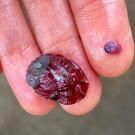
“Oh, because of Fukushima…” When beachgoers see my abalone shirt and ask about my conservation work, this is the misconception frequently returned to me in northern California. Coastal residents have been harvesting red abalone for hundreds of years, but recent population decline and closure of the last recreational fishery have brought abalone into the public’s eye.
Often I hear, “it’s because of the urchins!” or “climate change, am I right?”
Evan Tjeerdema spent the summer at Bodega Marine Laboratory, participating in both of the facility’s summer sessions. While there, he took classes like environmental toxicology and conducted two research projects: He studied the effects of environmental toxins on crab lavae and on predator-prey interactions using red abalone and starfish.
Research in the Marine Invertebrate Fisheries and Conservation Lab (resident scientist Laura Rogers-Bennett, Center for Wildlife Health and California Department of Fish and Wildlife) focuses on examining processes which impact marine invertebrate populations and communities then applying these findings to fisheries management and marine conservation issues. Marine invertebrates have become the most important fisheries in California in terms of both volume and value. In 2012, four of the top five fisheries were marine invertebrates.
The Shellfish Health Laboratory (SHL) at BML is the State Department of Fish and Wildlife’s shellfish health facility and is also a UCD Vet Med lab through the Principal Investigator, Colleen Burge. Findings from the SHL have been critical to the State of California and these include:
The giant sea snails, which eat seaweed and kelp, have been left with little to eat after the North Coast's kelp forests collapsed during the past three years. Now, hundreds of thousands, if not millions, of abalone are dead or starving.