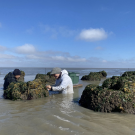
It’s the best oyster you’ve (probably) never tasted. For years, many people assumed it was gone from Tomales Bay altogether. But one day, Joe Newman, a Developmental Technician in the Aquatic Resources Group (ARG) at the University of California, Davis, Bodega Marine Laboratory (BML), got a call from a local oyster grower, who jokingly told him to “grab a bottle of hot sauce” and head to a nearby boat launch.
John & Mary Louise Riley Bodega Marine Laboratory Seminar Series: "Assessing the Capacity for Evolutionary Adaptation to Climate Change Stressors in Oysters and Fish"
The UC Davis Bodega Marine Laboratory's Aquatic Resources Group offers a glimpse into the world of oyster aquaculture. See the hatchery, where tiny Olympia oysters (Ostrea lurida) - the only oyster species native to the west coast of the US - are prepared for outplanting into the ocean.
This video was filmed and produced by Sam Briggs and features Joe Newman. Want to see more of Sam's work? Check out his science-meets-art photography on Instagram.
This guest blog highlights the experience of a Santa Rosa Junior College - Bodega Marine Laboratory Internship Program participant. The SRJC-BML Internship program is committed to creating an inclusive space for the development of new scientists and leaders and to provide interns with experience conducting research essential to developing careers in the sciences.