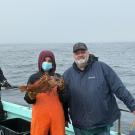
While they cover less than 1% of the ocean’s surface, the world’s four major upwelling zones are biological powerhouses. Located along the coasts of California, Chile, Portugal, and South Africa, these Eastern Boundary Upwelling Systems (EBUS) drive cold, nutrient-rich water to the surface, supporting massive populations of fish, birds, and mammals.
Mikaila Hishaw, a fourth-year marine and coastal science major from Tucson, Arizona, arrived at UC Davis with plans to become a veterinarian. She soon discovered that research offered not just a new way to work with animals but also an avenue to explore her curiosity beyond the classroom.
In this Peer Q&A, Environmental Policy Analysis & Planning major Toby Jacob and Marine & Coastal Science major Mikayla Leyson share what surprised them most, what challenged them, and what they gained from studying at the coast. From DNA extractions and fish embryos to tidepools, dorm life, and late-night stargazing, their stories capture both the rigor and the close-knit community that define the BML experience.
Their study systems are spread far and wide, from the inner delta to the coast and out into the open ocean, but their work is united in themes of change and community. Dr. John Durand, Dr. Hollis Jones, and Nicholas Trautman are all working to observe, understand, and apply science to a changing world.
Fourth-year UC Davis geology student Sonia Somasundaram was studying in the Cadet Hand Library at the Bodega Marine Laboratory when a fellow student burst through the library’s doors.
For more than a decade, the SRJC–BML Internship Program has connected Santa Rosa Junior College students with hands-on research experiences at the UC Davis Bodega Marine Laboratory.
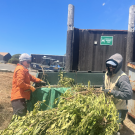
To wear or not to wear these clothing, that was my question everyday as a land steward intern. Most of my internship was spent outdoors doing fieldwork for habitat restoration, specifically invasive plants removal. I worked closely with my mentor Luis, the Bodega Marine Reserve steward, and Cabrilla.
My passion for wildlife, ocean ecosystems, and a love for the beach, led me to an incredible opportunity to bring that curiosity into the field through an internship at UC Davis’s Bodega Marine Laboratory (BML).
Hello, my name is Vanessa Cordova, and this summer, I had the chance to intern at the UC Davis Bodega Marine Lab through a partnership with Santa Rosa Junior College. I am a first-generation student transferring to UC Berkeley in the fall to study Integrative Biology with an emphasis in Human Biology. I came into this internship not really knowing what to expect. I wasn't sure how it would go or what I'd take away from it.
Hello, my name is Esmeralda Padilla-Garcia, and this summer I had the opportunity to intern at the UC Davis – Bodega Marine Laboratory through my school, Santa Rosa Junior College. I am currently enrolled at SRJC as a Biology major, and I plan to transfer to a university in Fall 2026. My passion lies in Human Biology and medicine, so participating in a marine biology internship was a step outside my comfort zone.