Melting and breaking icebergs in the far-off, northeastern region of the Pacific Ocean can weaken a massive current system in the Atlantic Ocean, according to a University of California, Davis study published in Nature Communications.
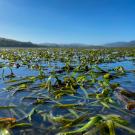
On her first day of graduate school, Karolina Zabinski rose at 4:00am. She spent the day on the muddy shores of Tomales Bay, collecting eelgrass for a survey of aquatic plant diseases. These ribbon-like seagrasses are common along the California coast and form knee-high meadows that undulate in the water.
While they cover less than 1% of the ocean’s surface, the world’s four major upwelling zones are biological powerhouses. Located along the coasts of California, Chile, Portugal, and South Africa, these Eastern Boundary Upwelling Systems (EBUS) drive cold, nutrient-rich water to the surface, supporting massive populations of fish, birds, and mammals.
Why are there so many species of coral reef fish? According to a new study, it’s because about 50 million years ago, some fish figured out how to bite food from hard surfaces.
Conducting environmental science in a time of rapid climate change can be like a game of Whac-a-Mole. Just as you get close, the focus moves, burns, melts or disappears.
Mikaila Hishaw, a fourth-year marine and coastal science major from Tucson, Arizona, arrived at UC Davis with plans to become a veterinarian. She soon discovered that research offered not just a new way to work with animals but also an avenue to explore her curiosity beyond the classroom.
Rarotonga, the largest island in the archipelago of the Cook Islands, is protected by a coral reef that forms a barricade around the kidney-shaped dollop of terra firma moored in the middle of the South Pacific. If that reef were to die off or disappear—as reefs are, globally, at a disheartening rate—it would spell catastrophe for Rarotonga’s more than 10,000 inhabitants. That partly explains how Anya Brown came to be a regular at a hardware store on the island.
California’s Bay Area may be a culinary hot spot for people, but food options for fish in the San Francisco Estuary have been limited and declining in recent decades. A study from the University of California, Davis, shows there is a part of the estuary that is teeming with fish food — the managed wetlands of Suisun Marsh.
Their study systems are spread far and wide, from the inner delta to the coast and out into the open ocean, but their work is united in themes of change and community. Dr. John Durand, Dr. Hollis Jones, and Nicholas Trautman are all working to observe, understand, and apply science to a changing world.
Resilience isn’t just something ecosystems do — bending, recovering, adapting in the face of stress. It’s something people do too. For UC Davis Ph.D. candidates Elisabeth Sellinger and Karolina Zabinski, resilience shows up in sediment cores and microbial communities, in carbon storage and stress responses, and also in career pivots, broken funding pipelines, and the uncertainty that shadows early-career science today.