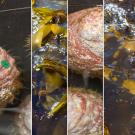
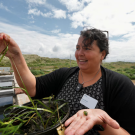
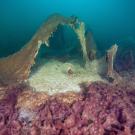
Along California’s coast, two ambitious efforts are reshaping how we approach restoration in a rapidly shifting world. The White Abalone Captive Breeding Program, led by Dr. Alyssa Frederick, and the Kelp RISES project, led by Dr. Marissa Baskett, working alongside a broad interdisciplinary team, are tackling ecological crises head-on.
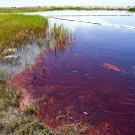
When oil spills or pollutants enter the ocean, the visible damage is only part of the story. Dr. Andrew Whitehead studies the genetic ripple effects—how exposure reshapes the biology of fish and other marine life for generations. His federally funded research helps reveal what industrial pollution leaves behind in coastal ecosystems, and why cleanup isn’t the end of the process. It’s science that connects environmental justice, molecular biology, and long-term ecosystem health.
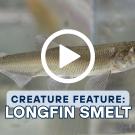
Join Karl Menard, Aquatic Resources Manager at the UC Davis Bodega Marine Laboratory, for a behind-the-scenes look at efforts to support longfin smelt in captivity.
What do you picture when you think of the California coast? Perhaps it’s the redwood-covered bluffs that plummet down to crashing waves, or the forests of kelp swaying along with the current. But the one thing that might not have come to mind has a surprising presence at UC Davis’ Bodega Marine Laboratory (BML): corals.
“So the clue was, ‘This temperate coral undergoes quiescence in the winter. Another word for this is … ?’” Anya Brown has spent most of her adult life around coral reef systems. Her brother, meanwhile, has cultivated a career as a writer on the American quiz show, “Jeopardy!”
The McMurdo Dry Valleys don’t look like they belong in Antarctica. Largely devoid of snow, the landscape is mostly dirt and rock. When explorer Robert Falcon Scott trekked the area in 1903, he referred to it as “the valley of the dead.”
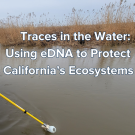
Tiny fragments of DNA permeate the air, soil, and water around us. This environmental DNA (eDNA) unlocks a non-invasive way to monitor biodiversity and detect species that might otherwise go unnoticed.
Looking at a jellyfish is like looking into the ancient past. Survivors from the late Precambrian Era, these organisms lived in an environment completely alien to the wide swath of modern Earth. They thrived during a time when the waters of our planet were largely anoxic, the lack of oxygen making them inhospitable to most animals existing today.
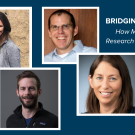
Scientists at the UC Davis Coastal and Marine Sciences Institute discuss how their research informs and is influenced by policy, illustrating the complex relationship between science, management, and decision-making.
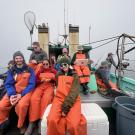
With funding from California Sea Grant, the California Collaborative Fisheries Research Program (CCFRP) provides an insightful volunteering experience with rockfish.