



Novelty in Unassuming Places: a Summer with the Owl Limpet
An SRJC-BML Internship Story
My name is Tyler Stanciu, and I’ve just wrapped up my third year at the Santa Rosa Junior College and am now preparing for my transition to UC Davis this upcoming fall, where I will be completing my undergraduate degree in Animal Science. I plan to specialize in behavior, although my interests also overlap with ecology and evolution. I am still exploring possible careers, and research in particular has always been intriguing yet unfamiliar to me. This program provided me the perfect opportunity to experience research firsthand, especially in a setting I could visualize myself in.
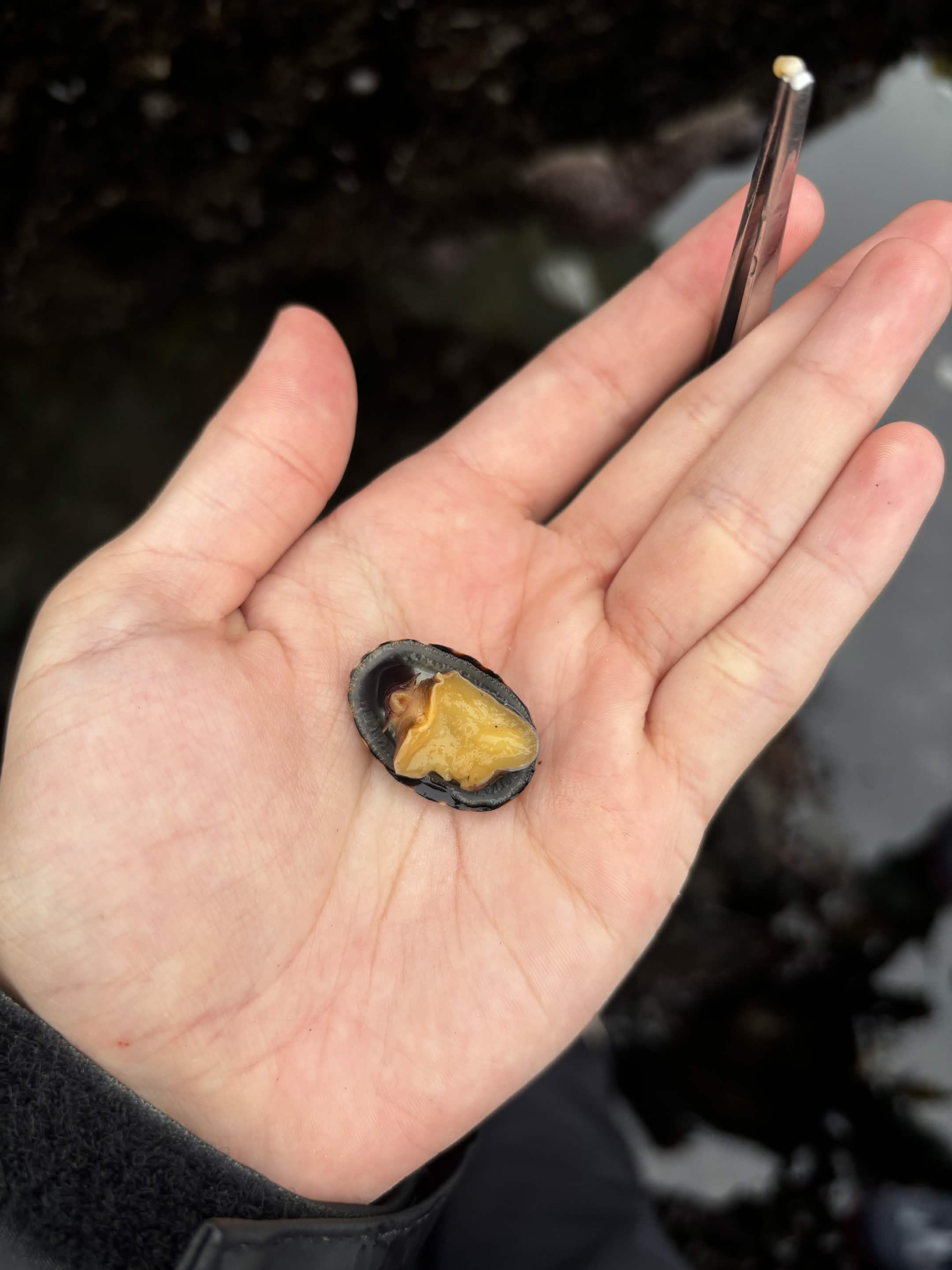
I spent the summer with my mentor, Julianna Porter, a PhD student studying the range expansion of the owl limpet (Lottia gigantea). While her dissertation is made up of multiple experiments, I assisted her work on studying size at sex change; owl limpets are protandric sequential hermaphrodites, meaning they all mature initially as males and then transition to females later in their lifetime. Julianna’s hypothesis is that females appear at smaller sizes in northern populations due to selective pressures. Unfortunately, previous studies have only been able to use lethal sampling methods to identify the sex of a limpet. For these newly established northern populations, this would be less than ideal, presenting the challenge of needing to develop a novel kind of nonlethal sampling. Because of this, Julianna is developing a way to sex limpets by analyzing gene expression from foot tissue samples.
A significant focus of my work this summer was in the field, where we found an interesting predator-prey dynamic: touching the tube foot of an ochre sea star (Pisaster ochraceus) to an owl limpet’s mantle frequently elicited a flee response which required the limpet to lift its shell, exposing its body and allowing for a foot tissue sample to be taken nonlethally. For someone interested in animal behavior, this was a fascinating discovery to me! Why would a hard-shelled animal expose its vulnerable body to a predator, rather than do what it does best and clamp down? Why do some limpets exhibit this response while others do not, and which will evolution favor, if either? How can this be tested in a lab setting, or observed in nature?
Through it all, this interaction continues to linger in my mind, and the questions it left remind me that science is a collaborative search for knowledge that continuously tests, validates, and expands upon previous work. Limpets and sea stars aside, though, there is so much I learned this summer—more than I could cover here. By helping with sampling, lab work, data entry, and doing some literature review, I saw the importance of critical thinking, problem solving, and observational skills. I got a great example of what research can look like under Julianna’s mentorship this summer. This opportunity significantly increased my confidence, and helped me better visualize a future in which I am a scientist like those I met at the Bodega Marine Laboratory.
About the Program:
The SRJC-BML Internship Program provides summer research opportunities for Santa Rosa Junior College students at the Bodega Marine Laboratory.