Kelp Forests

Sustainable Oceans NRT Program Participants Meet with Coastal Communities

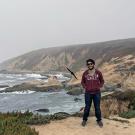
In June, students in the Sustainable Oceans NRT Program journeyed across California’s North Coast, meeting with residents, scientists, and managers to learn about the issues facing coastal communities. Here, Ellie Oldach recounts an experience visiting a marine science center and speaking to Pat, a local fisherman in Fort Bragg, CA. This article is printed with Pat’s permission.

The first thing we notice on entering the Noyo Center, Fort Bragg’s marine science and community hub, is a geodesic dome installed in the back of the room.

An Undersea Forest In Decline

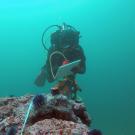
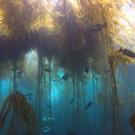
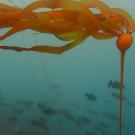
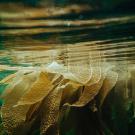
Envision California’s lush forests from San Francisco to the Oregon border. Now imagine that 90 percent of those forests disappear within two years. Laura Rogers-Bennett, senior environmental scientist with the California Department of Fish and Wildlife, says that’s exactly what happened to underwater kelp forests off Northern California’s coastline from 2014-16.

Read more & listen to the piece on Science Friday

Marine Invertebrate Fisheries and Conservation

Research in the Marine Invertebrate Fisheries and Conservation Lab (resident scientist Laura Rogers-Bennett, Center for Wildlife Health and California Department of Fish and Wildlife) focuses on examining processes which impact marine invertebrate populations and communities then applying these findings to fisheries management and marine conservation issues. Marine invertebrates have become the most important fisheries in California in terms of both volume and value. In 2012, four of the top five fisheries were marine invertebrates.